
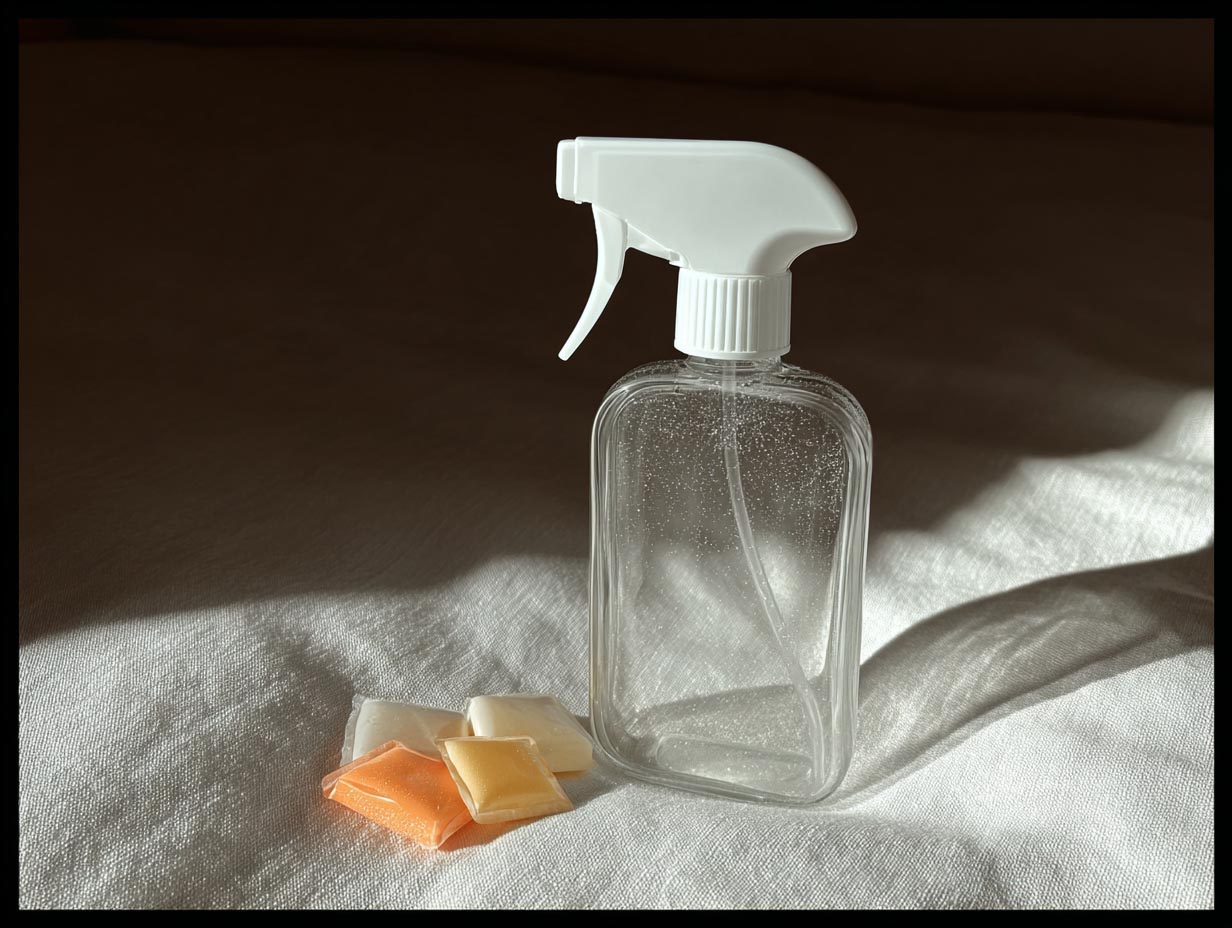
The cleaning products aisle has a problem that nobody talks about loudly enough: most of what you're buying is water. In a typical trigger spray or liquid detergent, water can account for 80 to 95 percent of the total volume. That water is manufactured, bottled, palletted, transported hundreds of miles, shelved, purchased, carried home, and eventually poured down a drain. At every stage, it costs energy, generates emissions, and consumes packaging.
Concentrated formats, specifically sachets, tablets, and dissolvable pods, exist to solve this problem. And as pressure mounts on manufacturers, retailers, and brands to demonstrate genuine sustainability credentials rather than surface-level claims, the concentrated format argument is becoming harder to ignore.
The logistics case
The numbers are straightforward. A single pallet of concentrated sachets can represent the equivalent cleaning output of several pallets of pre-diluted liquid product. Fewer pallets mean fewer vehicles. Fewer vehicles mean lower fuel consumption, lower emissions, and lower freight cost. For brands supplying into retail at scale, or shipping internationally, this is not a marginal efficiency gain. It is a structural reduction in the carbon footprint of the supply chain.
For UK manufacturers in particular, the argument is reinforced by proximity. A domestically produced concentrated product shipped to a UK retailer carries a fraction of the transport footprint of an equivalent imported liquid product travelling from continental Europe or further afield. When you combine concentrated format with local production, the carbon reduction compounds.
The packaging case
Concentrated formats also fundamentally change the packaging equation. A sachet or tablet requires significantly less packaging material by volume than its liquid equivalent. That matters for two reasons in the current UK regulatory environment.
First, the Extended Producer Responsibility for packaging scheme, which came into full effect in April 2025, charges manufacturers and brand owners based on the volume and recyclability of packaging they place on the market. Reducing packaging weight and complexity directly reduces EPR liability. From 2026, when modulated fees based on recyclability ratings come into force, packaging design choices become financially material in a way they have not been before.
Second, consumer expectations around packaging have shifted. Research consistently shows that a significant proportion of UK consumers consider packaging sustainability when making purchase decisions. A concentrated product in minimal, recyclable packaging tells a cleaner story on shelf than a large plastic bottle filled predominantly with water.
The formulation case
Concentrated formats place greater demands on formulation. Getting the active ingredients, preservatives, and fragrance systems to perform consistently when diluted by the consumer requires more sophisticated chemistry than a pre-diluted liquid. This is where manufacturing expertise becomes a genuine differentiator.
Not every contract manufacturer has the capability to formulate and produce concentrated products to a consistent standard. Dosing accuracy, stability across shelf life, and solubility performance all require tighter process control than standard liquid filling. For brands considering a move into concentrated formats, the choice of manufacturing partner is as important as the product concept itself.
The consumer behaviour case
Concentrated formats require a behaviour change from the consumer: measuring, diluting, dissolving. For years, this was considered a barrier to mainstream adoption. That assumption is being tested. The success of dishwasher and laundry tablet formats, now deeply embedded in UK consumer habits, demonstrates that when the format is convenient enough and the proposition is clear, dilution is not a deal-breaker.
The newer generation of dissolvable cleaning sachets, where the consumer simply drops a sachet into a reusable bottle and adds water, removes even that friction. The format is gaining shelf space in premium and independent retail, and beginning to attract attention from the major grocers. As the category develops, early-mover brands have an opportunity to define the positioning before it becomes commoditised.
The honest caveat
Concentrated formats are not automatically sustainable. A sachet made from non-recyclable multi-layer film, shipped from overseas in excessive secondary packaging, undermines the format's core argument. The sustainability case holds when the entire product system is considered: formulation, primary packaging material, secondary packaging, production location, and distribution model.
Brands and manufacturers who present concentrated formats as inherently green without interrogating the full supply chain are making a claim the market will increasingly scrutinise.
Done properly, though, concentrated formats represent one of the most credible and commercially viable routes available to cleaning and personal care brands that want to make a genuine reduction in their environmental impact, not just a marketing one.
Ready to start something
Get in touch with our team to discuss your next project or manufacturing challenge.
Read more insights
Explore our latest thinking on manufacturing and product development.


Stay informed on manufacturing
Subscribe to receive insights on product development, compliance updates, and industry trends.